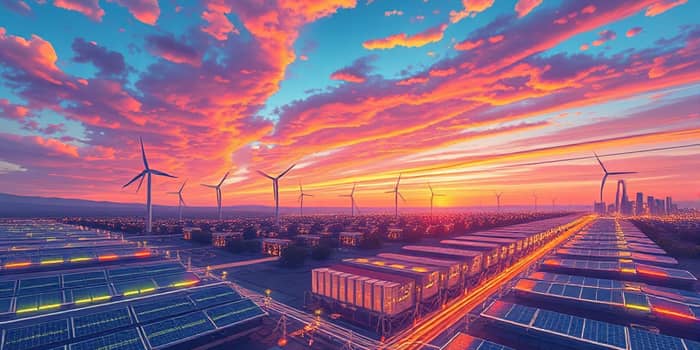
In an era defined by the urgent need to decarbonize global power systems, energy storage has transcended its niche role to become a cornerstone of the renewable transition.
From utility-scale battery parks to behind-the-meter systems, storage solutions are rapidly evolving to bridge the gap between intermittent generation and continuous demand, offering investors a compelling pathway to deliver both financial returns and climate benefits.
Global energy storage installations rose by more than 75% year-over-year growth in 2024, marking an unprecedented surge in combined capacity.
BloombergNEF projects 92 GW and 247 GWh additions in 2025 and 123 GW and 360 GWh deployments by 2026.
Analysts expect a 23% annual growth rate through 2035, propelling cumulative installations to a 2 TW and 7.3 TWh milestone by the end of the decade—over twelve times today’s capacity.
In the United States, operating storage capacity reached 37.4 GW as of October 2025, with 19 GW under active construction and a pipeline of 187 GW by 2030. Quarterly records continue to be broken: Q2 2025 saw 5.6 GW installed, adding to 11.9 GW for all of 2024.
As capital flows toward a low-carbon economy, energy storage has emerged as a magnet for diverse financiers, from venture capitalists to institutional investors.
The technological foundations of energy storage are undergoing a renaissance, balancing cost declines with performance gains.
Costs for lithium-ion batteries have plunged to a record low cost of $115/kWh in 2024, cementing their dominance in short-duration applications.
Meanwhile, long-duration storage solutions at scale—including flow batteries, compressed air, and green hydrogen—are scaling up to deliver more than eight hours of backup power.
Hybridization—pairing solar and wind with batteries—has become standard to manage price volatility and risk exposure and ensure round-the-clock backup power in sensitive applications.
Supportive policy frameworks in the US, Europe, and beyond have been instrumental in scaling storage deployment.
In North America, 23 states plus territories now mandate 100% clean targets, treating storage as a non-wires alternative for reliability to defer expensive grid upgrades.
The UK’s Clean Power 2030 program and the EU’s Long Duration Electricity Storage (LDES) scheme use cap-and-floor mechanisms to de-risk investments in both mature and emerging technologies.
Emerging markets such as India, Vietnam, and Brazil are launching utility-led tenders and incentives to integrate storage into national renewables targets.
Despite the rapid momentum, several headwinds could temper growth if not addressed proactively.
The outlook for storage is underpinned by multiple strategic drivers that promise to expand both scale and scope.
China leads in absolute deployments and benefits from lower capital costs per GW compared with other major markets, fueling rapid scale-up.
The United States boasts the largest project pipeline, supported by a robust blend of federal incentives and state policies.
Europe, especially the UK, focuses on long-duration solutions to bolster grid resilience under ambitious 2030 clean energy targets.
As storage evolves from an emerging technology to a fundamental grid asset, coordinated action among investors, policymakers, and technology providers will be crucial to unlocking its full potential and securing a resilient, low-carbon energy future.
References