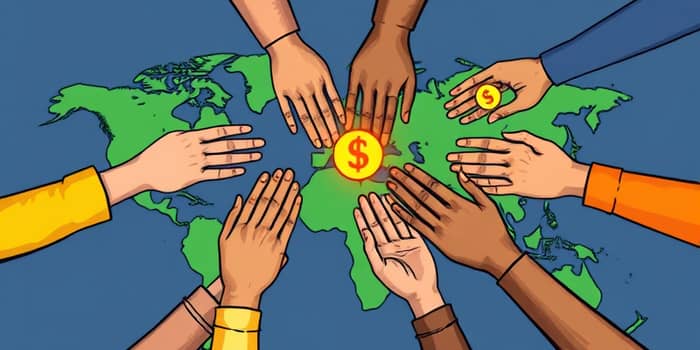
In 2025, the journey of money—from a single individual’s pocket to the farthest corners of the globe—has become a defining force shaping economies and societies. As digitalization, real-time systems, and fintech innovations converge, the way we send, receive, and manage funds is undergoing a profound evolution. This article explores the landscape of modern money movement, highlights key drivers, examines challenges, and charts a path toward a more inclusive and sustainable financial ecosystem.
Money movement today encompasses everything from peer-to-peer transfers to multi-trillion-dollar cross-border flows. Every day, more than 10 trillion dollars in value changes hands across over 200 countries and 120 currencies. With real-time systems powering more than 60 million transactions daily, the average payment now settles in seconds rather than days.
Behind this rapid transformation lies a straight-through processing rate of 99.5%, a testament to system resilience and automation. Whether paying for groceries, sending remittances to family abroad, or settling corporate invoices, seamless financial transactions worldwide are rapidly becoming the norm, raising both expectations and responsibilities for providers and regulators alike.
Several powerful trends are converging to redefine how money moves locally and globally. These drivers not only enhance efficiency but also push the boundaries of financial inclusion and innovation.
Real-time payments have proliferated across more than 70 countries, offering instant settlement and visibility. Meanwhile, global cash usage has declined to 46% of all transactions, as account-to-account and e-wallet solutions capture increasing market share at point of sale. In emerging markets, digital transactions per adult jumped from 55 in 2017 to 251 in 2024, driven by aggressive mobile money rollouts.
At the same time, stablecoins and tokenized money have matured, with a market capitalization of around $270 billion and daily transaction volumes nearing $30 billion. Programmable money, coupled with AI-driven payment optimization, is unlocking flexible, automated cross-border flows and smart contract–based settlements. In the lending space, Buy Now, Pay Later (BNPL) reached $350 billion in transaction value in 2024, while peer-to-peer lending facilitated $62 billion globally, empowering new economic actors.
The global money movement landscape varies significantly by region, influenced by consumer preferences, regulatory frameworks, and local infrastructure. Understanding these nuances is critical for providers seeking to expand or adapt their offerings.
As money movement becomes more digital and global, operational and regulatory complexities multiply. Geopolitical tensions and sovereignty concerns have led to fragmented rails and divergent technical standards. Providers must navigate real-time sanctions screening, anti-money laundering obligations, and a constantly evolving threat landscape.
Cybersecurity risks continue to escalate, demanding robust operational resilience and advanced threat detection. At the same time, regulators struggle to balance innovation with stability and consumer protection. Initiatives like Brazil’s Pix and Europe’s Instant Payment scheme reflect localized solutions, while multilateral efforts aim to establish interoperable standards.
Beyond efficiency and profit, responsible money movement holds the promise of social impact. According to the IMF Financial Access Survey 2025, mobile money and digital payments have brought millions into the formal financial system, particularly in Sub-Saharan Africa and South Asia.
Lower transaction costs and faster settlements enable migrants to send funds home at a fraction of previous fees, boosting household incomes and local economies. This bringing millions into formal finance underpins sustainable development and poverty reduction, aligning with global Sustainable Development Goals.
Artificial intelligence and machine learning are deeply embedded in modern payment systems. From real-time fraud detection to risk management and operational optimization, AI solutions deliver AI-driven payment optimization that enhances security and customer experience.
Digital wallets—whether bank-branded, fintech-powered, or crypto-native—serve as key enablers of both domestic and cross-border flows. By offering transparent fees, instant confirmations, and programmable features, these tools support businesses and individuals alike in navigating an increasingly interconnected financial world.
To move money responsibly from pockets to the planet, stakeholders must embrace environmental and social governance alongside inclusion and innovation. Cutting transaction and remittance costs fosters financial access for low-income and rural communities, while privacy, data protection, and consumer rights must remain at the forefront.
Looking ahead, two scenarios compete for dominance: a multirail global ecosystem underpinned by interoperable passkeys and standards, and a more fragmented landscape driven by regionalization. The most resilient outcome will emphasize financial inclusion, transparent pricing, and sustainable innovation. By aligning commercial interests with social impact, we can ensure that the flow of money uplifts individuals, communities, and the planet alike.
In the evolving story of money movement, every transaction is a step toward a more connected, equitable world. From a consumer tapping a mobile wallet in a remote village to a multinational corporation settling cross-border invoices, the choices we make today will define the financial landscape of tomorrow. Let us move money not just quickly, but wisely, responsibly, and inclusively—from pocket to planet.
References