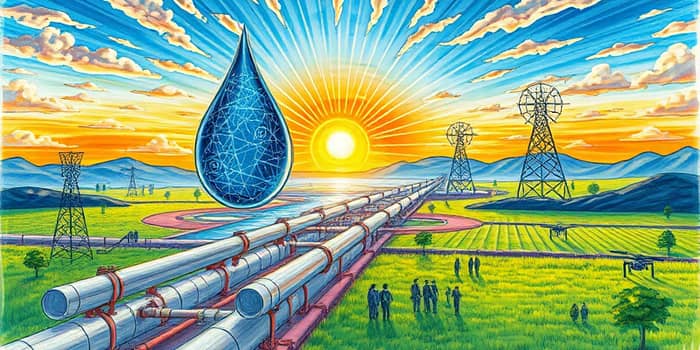
Water is life’s indispensable thread, weaving together ecosystems, economies, and societies. As global demand soars, the world stands at a crossroads: continue down a path of scarcity, or seize the moment to revolutionize water management and secure a sustainable future for all. This article explores the gravity of the current crisis, the promise of innovation, and the investment strategies that can transform a precious resource into a catalyst for growth and resilience.
Today, water scarcity is no longer a distant threat—it is a pressing reality. In 2024, an estimated 2.2 billion people lacked access to safely managed drinking water, while 3.4 billion were deprived of adequate sanitation, and 1.7 billion had no basic hygiene services.
Meanwhile, global population growth—projected to exceed 10 billion by 2050—drives a projected 55% increase in water consumption. If current trends persist, up to 40% of humanity could face severe water scarcity by 2040.
These figures underscore the need for immediate, bold action that blends technology, policy, and finance to safeguard every drop.
Certain regions face critical levels of stress, with Northern Africa, Western Asia, and parts of Central and Southern Asia operating above 75% water stress. In these areas, even minor supply disruptions can trigger humanitarian crises.
Rural communities, largely reliant on rainfed agriculture, are especially vulnerable. Meanwhile, booming cities in emerging economies strain aging infrastructure, compounding distribution losses and water quality risks.
Targeted regional strategies—tailored to local climates, economies, and social structures—are essential for bridging the gap between abundance and scarcity.
Despite the urgent need, global water infrastructure financing gaps run into the trillions. Underinvestment has far-reaching consequences: inefficient irrigation leads to crop failures, industrial leaks halt production, and untreated wastewater contaminates ecosystems.
Progress on water-use efficiency is uneven. Between 2015 and 2022, overall efficiency improved by 23%, but 57% of countries still operate below the benchmark of $20 per cubic meter. Disparities are stark: $38.5/m³ in industry, $114.4/m³ in services, and a mere $0.7/m³ in agriculture.
Encouragingly, 96% of water sector investors plan to maintain or increase funding in 2025, and over 30% committed more than USD 500 million in 2024. Yet coordinated action is needed to channel capital into the most impactful innovations.
The smart water management market is on a steep growth trajectory, rising from USD 23.7 billion in 2025 to an estimated USD 43.7 billion by 2030 (CAGR 13%). Cutting-edge technologies are transforming supply chains and bolstering resilience against climate extremes.
Applications span urban water grids, industrial wastewater analysis, flood and drought management, and climate adaptation measures, creating multiple entry points for investors and policymakers.
Integrated Water Resources Management (IWRM) adoption rose from 49% in 2017 to 57% in 2023, yet most countries still lack robust revenue mechanisms and subnational funding. The pathway to resilience blends regulatory reforms with market incentives.
Key approaches include:
Reforming agricultural practices—shifting from water-intensive crops and upgrading irrigation—can unlock significant efficiency gains, particularly in drying regions.
Water insecurity threatens the health and livelihoods of up to 4.8 billion people, especially in poor and underserved communities. Diarrheal diseases, malnutrition, and gender inequities are exacerbated by inadequate water and sanitation.
Urban areas can leverage smart-water solutions to accelerate progress, but rural regions risk being left behind without targeted capital and capacity-building.
Climate adaptation strategies must integrate water management, as shifting precipitation patterns and extreme events reshape resource availability.
Addressing the water crisis demands collective action, underpinned by strategic investment, cross-sector collaboration, and unwavering political will. Stakeholders must unite to deploy scalable, data-driven solutions that fortify communities and ecosystems.
Investors can catalyze this transformation by directing capital towards high-impact technologies, sustainable infrastructure, and innovative financing models such as green bonds and blended finance.
By investing in water management today, we secure not only a vital resource but also the foundation of human health, economic prosperity, and environmental resilience. The time to act is now—every drop counts.
References