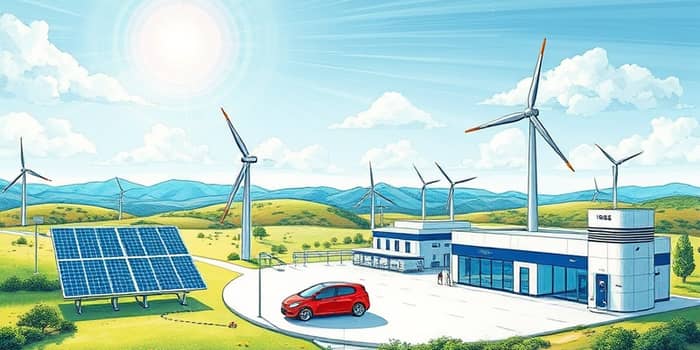
The pace of change in the energy sector has never been more dramatic. As global priorities shift toward net-zero goals, global clean energy investment has surged past traditional fossil fuel funding, opening doors to unprecedented technological breakthroughs.
In 2025, clean energy technology investments are projected to hit $670 billion, eclipsing upstream oil and gas for the first time. This milestone underlines a fundamental shift in capital flows. Investors—from pension funds to venture capital—are directing resources toward solar, wind, and emerging solutions with the confidence that these technologies offer both returns and a path to decarbonization.
In the United States alone, clean energy and transportation funding reached $68 billion in Q2 2025, representing 4.8% of private investments. Over the past four quarters, this figure climbed to $276 billion, driven by a surge in distributed solar, zero-emission vehicles, and heat pumps. The Inflation Reduction Act has catalyzed these flows, with $351 billion invested over three years and $517 billion committed to 2,203 planned facilities.
Diversification across technology segments is critical to a resilient transition. Investors now deploy capital across mature and emerging solutions, balancing risk and reward to meet climate targets.
Key segments include:
Several forces converge to steer investment toward clean technologies, from national security to corporate mandates.
Regional dynamics also shape capital efficiency. China achieves nearly twice the gigawatts per dollar invested compared to the US, reflecting streamlined permitting and scale advantages. In contrast, the US benefits from robust industrial policy under the IRA, fostering local manufacturing and high-value jobs.
Despite robust growth, challenges persist, threatening to slow momentum.
Project developers must navigate supply chain disruptions, community engagement, and grid integration hurdles. Financial institutions, in turn, need innovative instruments—green bonds, blended finance—to de-risk long-term clean energy projects.
The clean tech revolution extends beyond power generation. Decarbonizing heavy industry—cement, steel, aviation—requires new pathways. Clean hydrogen, carbon capture, and sustainable aviation fuels are at the forefront, with pilot plants demonstrating scalable emissions reductions.
At the same time, the AI and data center boom fuels demand for reliable, zero-carbon electricity. Analysts forecast a corporate clean energy procurement surge that could push annual global off-take to 300 TWh by 2030, up from 200 TWh in 2025.
These developments generate high-quality jobs in manufacturing, installation, and operation, with localized economic benefits that bolster community support for clean energy projects.
Looking forward, clean technology investors and policymakers must align on several strategic priorities:
Ultimately, current investment levels remain insufficient to meet climate goals—tripling renewable capacity by 2030 demands an annual spend several times higher than today’s. Yet, the ongoing influx of private capital, aligned with supportive policies and corporate demand, inspires confidence.
For investors, entrepreneurs, and policymakers alike, the moment to act is now. By channeling resources into scalable, cost-effective clean technologies, we can drive innovation, create jobs, and forge a sustainable future. Each dollar invested stakes a claim in tomorrow’s economy—one powered by the sun, the wind, and the ingenuity of human minds.
As we witness the largest energy transition in modern history, tripling renewable capacity by 2030 is not just a target but a rallying cry. Together, we can turn ambition into action and investment into impact.
References