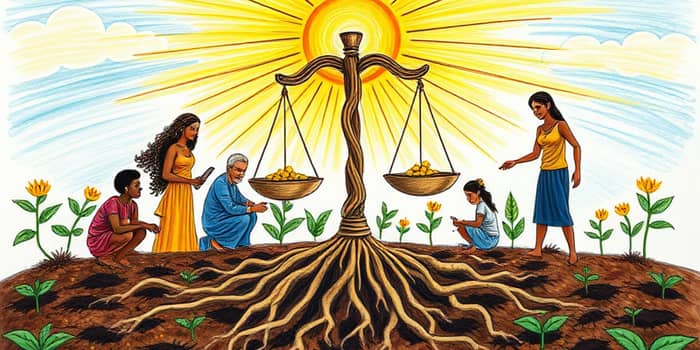
In an age marked by towering fortunes and widening social gaps, we must ask not only how wealth is generated, but whether that process sustains the dignity of every person. This modern perspective on ethical wealth creation brings together philosophy, data, technology, and practical action to forge pathways toward a more just economic future.
At the core of ethical wealth creation lies a tapestry of moral theories demanding attention to both rights and responsibilities. These frameworks guide our understanding of fairness, obligation, and human flourishing.
Rawlsian thought argues that inequalities are justifiable only if they uplift the least advantaged. Utilitarianism stresses maximizing overall societal well-being, while libertarianism champions individual autonomy over forced redistribution. Catholic social doctrine complements these by highlighting the moral imperative of work and wealth serving the common good.
Data on global wealth concentration reveal stark disparities across nations. The richest ten percent own over half of all income and nearly three-quarters of global assets. Such imbalance challenges the moral fabric of communities worldwide.
By contrast, Slovenia and Slovakia maintain coefficients below 25, showcasing models for narrowing wealth gaps. Understanding these extremes informs policies that can ethically rebalance resources.
Within the United States, the richest 0.01% saw incomes grow over 1,000% since 1979, compared with just 132% for the bottom quintile. Meanwhile, median earnings differ sharply across racial lines, with white workers earning nearly a quarter more than Black workers.
Public assistance and progressive taxes have somewhat narrowed the divide, yet millions still struggle on incomes under $15,000 annually. Persistent barriers to social mobility raise urgent ethical questions about opportunity and dignity.
The rise of networked platforms has ushered in winner-take-all dynamics, concentrating power and profits in the hands of a few dominant firms. Algorithmic bias in finance and hiring systems often reproduces historical injustices.
These challenges call for robust oversight, inclusive design practices, and ethical AI frameworks to ensure technology becomes a tool for empowerment, rather than exclusion.
Economic systems lie on a spectrum between unfettered markets and full public control. Each model offers lessons on aligning prosperity with equity.
Finding a balanced approach means embracing market innovation while safeguarding fundamental rights to healthcare, education, and a living wage.
Despite its pitfalls, technology holds promise for democratizing opportunity. Fintech innovations can bridge banking gaps for underserved populations. Blockchain offers transparent ownership records that resist manipulation.
Open-source platforms empower communities to share knowledge and resources, fostering collaborative ventures rather than zero-sum competition. Responsible tech governance and public-private partnerships can steer these tools toward inclusive growth.
Sustainable and socially responsible investing channels capital toward enterprises that honor environmental stewardship and human rights. This trend proves that profit and purpose need not be mutually exclusive.
By integrating environmental, social, and governance criteria into decision-making, investors become active stewards of a future where wealth creation contributes to planetary health and community well-being.
Surveys across 36 countries show a majority view wealth inequality as a severe national problem. This growing awareness fuels social movements demanding transparency, corporate accountability, and equitable policies.
The moral energy of those calling for change is potent, but translating public sentiment into lasting reform requires institutional courage and visionary leadership.
Every individual can play a role in shifting the economic paradigm toward fairness:
Reflect on personal values and spending habits to align with social impact. Advocate for progressive taxation and universal basic services. Mentor entrepreneurs from marginalized backgrounds, sharing skills and networks.
Support businesses with transparent supply chains and fair labor practices. Engage with community development projects that build affordable housing, cooperative enterprises, and local skill-building programs.
These actions, multiplied across millions, can reshape the contours of wealth toward shared prosperity.
The ethics of wealth creation is not an abstract intellectual exercise but a lived journey demanding empathy, courage, and collective imagination. By grounding our aspirations in moral clarity and practical engagement, we can build a world where abundance uplifts every life.
May this modern perspective inspire you to be both a prosperous creator and a compassionate steward, ensuring that the fruits of innovation and labor are shared, cherished, and sustained for generations to come.
References