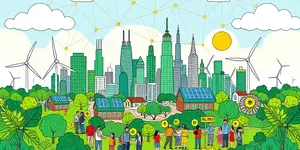
The financial world stands at a pivotal crossroads. As climate risks intensify and societal expectations shift, institutions must embed environmental and social considerations at the heart of decision-making. Sustainable finance has soared from a niche concept to a core strategic priority, redefining how capital is allocated, risks are assessed, and value is created.
In 2024, the global sustainable finance market reached $5.87 trillion. Projections suggest a staggering 19.8% CAGR through 2034, energizing investors and policymakers alike.
Recent statistics reveal sustained momentum in sustainable finance. The market expanded to $8.2 trillion in 2024, a 17% year-over-year rise, per UNCTAD. Sustainable assets under management rose to $3.2 trillion, while sustainable debt issuance climbed 8%, hitting $1.6 trillion.
Despite a temporary dip in sustainable loan origination—falling 18% to $390 billion in H1 2025—activity shows early signs of recovery. Experts forecast that sustainable bond issuance will surpass $1 trillion by year-end 2025, underscoring robust demand.
Capital flows are increasingly guided by a constellation of drivers, each reshaping the financial ecosystem.
Investor behavior is also shifting. Consolidation among sustainable funds—7,510 globally in 2024—signals heightened scrutiny. Exclusionary screening against fossil fuels and controversial weapons now dominates selection criteria.
Financial markets have diversified sustainable offerings beyond traditional green bonds. A rich array of instruments addresses varied risk-return profiles and impact objectives.
Major transactions, such as Deere & Co.’s $11.5 billion sustainable loan, underscore corporate commitment to decarbonization. Multilateral development banks are stepping up, pledging $120 billion annually by 2030 and $300 billion by 2035 for climate projects.
Sovereign, supranational, and agency (SSA) issuers led with $530 billion in sustainable issuance in 2024. Meanwhile, community development financial institutions saw assets surge 615% since 2014, reaching $458 billion in 2023.
Corporate issuance softened where subsidies receded, but banks are expanding green lending programs to meet upcoming EU Green Asset Ratio reporting. Community lenders and CDFIs drive financial inclusion, marrying social impact with capital growth.
While Europe remains the regulatory vanguard, APAC and EMEA show remarkable growth in green bond and loan markets. The United States, navigating policy oscillations, innovates through tax credits and blended finance to sustain momentum.
Emerging markets and developing economies (EMDEs) are not far behind. Across 72 EMDEs, ESG integration and climate risk management are central to national financing strategies. These regions are pivotal for closing the $2.7 trillion annual SDG funding gap.
Investing in nature-positive transitions could unlock $10 trillion in annual business value and 400 million jobs by 2030. Annual climate finance rose by 26% from 2021 to 2023, demonstrating an accelerating pace of capital deployment.
This snapshot illustrates how converging trends in finance, policy, and technology are delivering measurable social and environmental impact.
The path to mainstreaming sustainable finance is laden with both promise and complexity.
Financial institutions that embrace these challenges stand to reap long-term benefits. Embedding sustainability into core strategy not only mitigates risk but unlocks new revenue streams, fosters resilience, and aligns with a broader purpose-driven ethos.
Looking beyond 2025, the integration of decarbonization targets, advanced digital infrastructure, and nature-positive investments will define industry leaders. Collaboration across sectors—public, private, and philanthropic—will be essential to channel capital where it matters most.
There is no longer a choice between growth and sustainability. Instead, sustainable finance as a core strategy is the linchpin for enduring success. By aligning capital with the planet’s needs and societal goals, finance can catalyze a resilient, equitable, and thriving future.
References