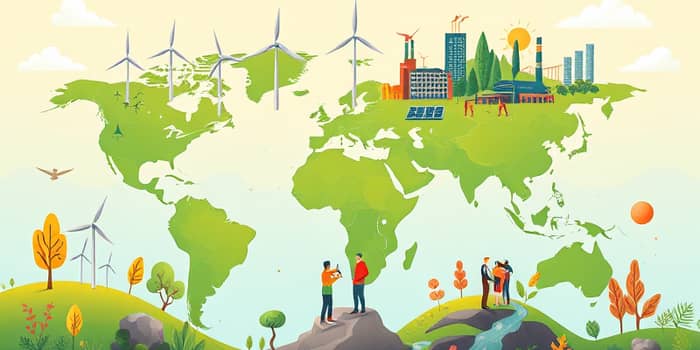
As nations around the world confront the twin challenges of climate change and economic recovery, the transition to a green economy has emerged as both an imperative and an opportunity. By 2025, renewables are poised at a critical inflection in 2025, offering nations a chance to reshape industries, foster innovation, and reduce emissions simultaneously.
Renewable energy costs have plummeted in recent years, making solar 41 percent cheaper and wind 53 percent cheaper than fossil alternatives. This has driven renewables to represent 92.5% of all new electricity capacity additions globally in 2024. Meanwhile, global electricity consumption climbed 4.3 percent in 2024, underscoring the need for continued investment in clean supply.
China’s solar production in the first quarter of 2025 matched its entire 2020 output, and clean energy now accounts for roughly ten percent of the nation’s GDP. As data centers and extreme weather events increase energy demand, the tension between consumption and clean supply becomes more acute.
The green technology and sustainability market is forecast to reach $73.9 billion by 2030, driven by AI integration, ESG compliance, and global demand for low-carbon processes. Today’s broader green transition opportunities span minerals, manufacturing, materials, and services, valued at two trillion dollars and potentially rising to $11 trillion by 2040.
Key sectors poised for expansion include critical energy-transition minerals and green tech manufacturing, projected to grow from $800 billion in 2024 to $3 trillion by 2030. Low-carbon industrial materials and green services such as climate adaptation also offer significant upside.
Europe leads the global green market, propelled by the EU Green Deal and carbon neutrality targets. Denmark generates 70 percent of its energy from renewables, with wind exports adding five percent to regional GDP. Asia-Pacific is the fastest-growing region through 2030, led by China’s ten percent clean energy GDP share and India’s rapid solar buildout.
Costa Rica offers a model of near-total renewable integration, achieving 99 percent renewable electricity and demonstrating how environmental stewardship can align with economic progress. Regions embracing green technologies often see 25% higher investment than less green counterparts, with some experiencing more than 200 percent growth in sustainable industries.
Green technology could create 1.5 million new jobs globally by 2030, especially in regions scaling renewables and AI-optimized grids. Denmark’s wind sector alone added two thousand positions in manufacturing and maintenance in 2025, exemplifying how targeted development spurs regional employment.
Major infrastructure projects, such as large-scale wind farms or solar parks, often catalyze fifty million dollars in local investment each, funding upgrades to grids, roads, and community services. FDI flows increasingly favor regions with strong ESG credentials, reinforcing the economic case for sustainability.
Despite the promise of clean energy, significant barriers remain. Large upfront capital requirements for solar and wind installations can deter smaller economies. Workforce shortages, particularly in rural areas, hamper adoption of advanced technologies. Regions must also build resilience against energy demand spikes from data centers and extreme weather.
Market volatility and geopolitical tensions pose additional headwinds. Trade disputes, such as US-China tariffs on renewable components, threaten supply chains. Early 2025 saw an eighty-nine percent drop in asset-level deals compared to the previous year, signaling investment caution in some quarters.
Governments and businesses must collaborate through public-private partnerships critical for scaling projects, funding training, and sharing risk. Advanced economies should invest in green manufacturing innovation and lower energy costs to maintain global competitiveness.
Emerging markets need targeted incentives to attract foreign investment, develop domestic supply chains, and build climate resilience. Clear sustainability credentials enhance a region’s appeal for investors and position it as a global green leader.
While global growth may moderate due to trade uncertainties and economic headwinds, the net-zero transition presents a transformative opportunity. Innovations in storage, smart grids, and green finance instruments will drive the next wave of growth and stability. As asset-level deals recover post-2025, regions that invest early will reap significant long-term dividends.
By aligning policy, investment, and community engagement, nations can navigate the green shift to secure economic growth, job creation, and environmental stewardship. The pathway to a decarbonized economy will not be free of challenges, but the rewards for leadership and innovation promise to be profound.
Embracing the global green shift is more than an environmental choice—it is an economic strategy that redefines competitiveness, resilience, and prosperity for generations to come.
References