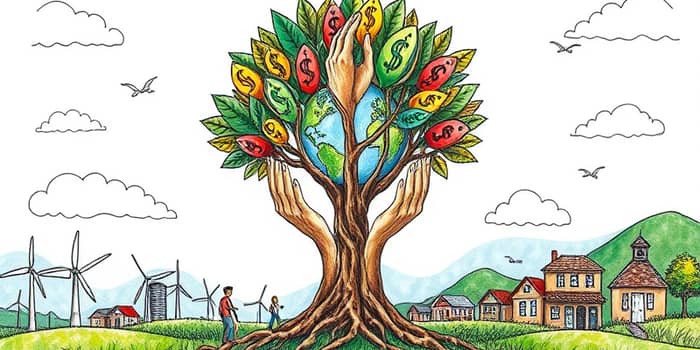
In a world grappling with climate change, social inequality, and ecological breakdown, the demand for finance that not only yields returns but also catalyzes positive transformation has never been stronger. This article examines how trust underpins every green investment and why ethical finance is the cornerstone of sustainable prosperity.
Trust is the invisible thread that connects investors, communities, and the planet. Without it, capital flows stagnate, and ambitious sustainability projects falter. Ethical finance is built on a foundation of transparent and accountable systems, creating the social license necessary for large-scale green initiatives to flourish.
By aligning financial returns with environmental and social impact, ethical finance bridges the gap between profitability and purpose, demonstrating that financial markets can be engines of positive change.
The global sustainable finance market was valued at $7.95 trillion in 2025 and is on an unprecedented growth trajectory, projected to hit $38.19 trillion by 2034 at a robust CAGR of 19.2%. Europe leads with $3.18 trillion in 2025, while the UK alone represents 25% of that share.
Sustainable debt issuance has exceeded $1 trillion annually for the past five years, reflecting a maturation of green bonds, social bonds, and sustainability-linked bonds as key instruments of change.
These numbers underscore the sheer scale of capital now devoted to sustainability and ethical initiatives, signaling a paradigm shift in global finance.
Ethical finance extends beyond traditional metrics of profit. It integrates Environmental, Social, and Governance (ESG) criteria with the United Nations Sustainable Development Goals (SDGs), fostering investments that deliver measurable societal and environmental benefits.
By prioritizing purpose alongside performance, ethical finance redefines success to include positive outcomes for people and the planet.
Contrary to early skepticism, sustainable funds are outperforming their traditional counterparts. In the first half of 2025, the median return for ethical funds reached 12.5%, compared to 9.2% for conventional funds. This outperformance represents the strongest variance since 2019 and has driven record inflows.
Around 80% of young investors now plan to increase their sustainable allocations, seeking not only economic returns but also the emotional satisfaction of aligning investments with personal values.
The rise of green bonds, social bonds, and sustainability-linked bonds has been complemented by innovative structures such as blended finance vehicles and impact bonds. Digital transformation accelerates this evolution:
These technologies provide investors with unparalleled transparency and verification, reinforcing trust and ensuring that capital is deployed where it truly counts.
In 2025, climate mitigation and adaptation remain top priorities, with significant capital flowing into clean energy, energy efficiency, and disaster resilience. Nature-positive finance—driven by biodiversity, water security, and regenerative agriculture—has surged from $9.4 billion in 2020 to over $100 billion in 2024.
Social bonds, while smaller in volume than green bonds, are gaining traction through landmark issuances such as Standard Chartered’s €1B social bond aimed at SME growth and essential services in low-income countries.
Several forces converge to sustain the momentum of ethical finance:
Regulators, particularly in the EU, are tightening criteria and reporting standards, while multilateral development banks pledge up to $300 billion in annual climate financing by 2035, creating an environment ripe for growth.
No transformation is without friction. The market faces persistent concerns around greenwashing, where claims of sustainability lack credible backing. Data gaps, especially in biodiversity metrics, hinder comprehensive impact assessment.
Authenticity and rigorous verification are essential to maintain confidence. Progress in standardization, such as the EU Green Asset Ratio and draft taxonomy frameworks, aims to close these gaps and hold issuers accountable.
Emerging examples illustrate the power of trust-driven finance. EMSTEEL’s Green Finance Framework, the first of its kind in the Middle East, enabled the company to secure green bonds and loans for decarbonization upgrades.
At COP29, a coalition of multilateral development banks (MDBs) increased climate finance commitments by 30%, demonstrating how public-private collaboration can unlock capital at scale.
Looking ahead, ethical finance is poised to expand into underbanked regions across Asia and Africa, leveraging inclusive products to empower SMEs and local communities. Digital innovations will continue to refine ESG data, enabling investors to track social and environmental outcomes with ever-greater precision.
Building deeper trust through transparent governance will be critical as the sector matures. By embedding ethical principles into the DNA of financial markets, we can mobilize trillions of dollars toward a regenerative, equitable future for all.
Ultimately, the Trust Factor is not just a concept—it is the principle that will determine whether finance can truly serve the needs of people and the planet, ensuring that growth is sustainable, inclusive, and enduring.
References